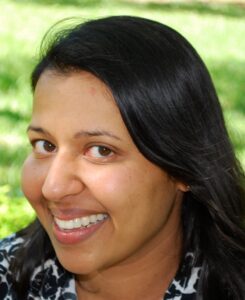
Associate Investigator\, McGovern Institute
Prof essor\, Brain and Cognitive Sciences\, MIT
Director\, K. Lisa Yang ICo N Center\, MIT
Ila Fiete\, PhD
Associate Investigator\, McGovern Institute
Prof
essor\, Brain and Cognitive Sciences\, MIT
Director\, K. Lisa Yang ICo
N Center\, MIT
Hippocampal circuits in the brain enable two distinct cognitive functions: the construction of spatial maps for navigation and th e storage of sequential episodic memories. This dual role remains an enduri ng enigma. While there have been significant advances in modeling spatial r epresentations in the hippocampus\, we lack good models of its role in epis odic memory. Additionally\, we now know that the spatial codes in grid and hippocampal cells generalize to represent non-spatial cognitive domains\, b ut it is unclear why this arrangement might be advantageous. In this talk\, I’ll discuss a neocortical-entorhinal-hippocampal network model that imple ments a high-capacity and flexible general associative memory\, spatial mem ory\, and episodic memory based on a scaffold of rigid\, low-dimensional dy namics in grid cells and fixed random projections to the hippocampus. The c ircuit factorizes the problem of content storage from the problem of genera ting error-correcting stable states. Unlike existing neural memory models\, which exhibit a memory cliff\, the circuit exhibits a graceful tradeoff be tween the number of stored items and detail. The scaffold is also critical for constructing episodic memory: it enables high-capacity sequence memory by simplifying the chaining problem into one of learning low-dimensional tr ansitions. The model recapitulates a number of hippocampal physiology resul ts\, and interestingly provides a potential explanation for the striking ef ficacy of the ``memory palaces'' technique of memory athletes.
CATEGORIES:Seminar Series LOCATION:Neuroscience Research Building Auditorium GEO:38.635602;-90.254892 ORGANIZER;CN="Shea":MAILTO:shea.stewart@wustl.edu URL;VALUE=URI:https://neuroscience.wustl.edu/events/event/department-of-neu roscience-seminar-ila-fiete/ END:VEVENT BEGIN:VTIMEZONE TZID:America/Chicago BEGIN:STANDARD TZOFFSETFROM:-0500 TZOFFSETTO:-0600 DTSTART:20251102T070000 TZNAME:CST END:STANDARD END:VTIMEZONE END:VCALENDAR