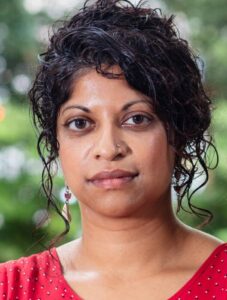
Priya Rajasethupathy - The Rockefeller University
How do fleeting molecules and dynamic neural patterns succeed in converting transient experiences in to lasting internal representations? And how do these initial memory repres entations continuously reorganize in the brain into progressively more endu ring forms? The Rajasethupathy lab explores fundamental questions about the dynamic and distributed nature of memory from inception to long-term stabi lization.
Towards these goals\, the lab bridges forward geneti cs\, cell biology\, and systems neuroscience to provide cross disciplinary insights. On the one hand\, they perform genetic mapping in outbred mice fo r unbiased discovery of the genes\, cell types\, and circuits relevant for memory across different timescales. In parallel\, they develop and apply te chnologies to record high-resolution neural activity from these relevant ci rcuits over chronic timescales in the behaving animal. Through a convergenc e of these approaches\, they develop insight into the functional changes go verning the evolution of a memory\, and how this may go awry in disease.
Using these approaches\, the lab recently studied a cohort of genetical ly diverse outbred mice and identified a single genetic locus of large effe ct driving substantial variability in short-term memory. Characterization o f causative gene\, a novel orphan brain receptor functioning in the thalamu s\, and in-vivo imaging across related neural circuits are providing an ent ry point to formulate and test new models of short-term memory.
In pa rallel studies on longer timescale memory\, the lab is characterizing how m emory representations initially form in the hippocampus over hours to days\ , and eventually stabilize across the brain over weeks. To form insights in to this brain reorganization process\, they have developed behavioral tasks to study how multimodal cues are integrated during memory formation and re call\, and over time\, why some memories are consolidated while others are forgotten. As mice perform these memory-guided tasks\, the lab develops and applies methods to longitudinally track neural activity in brain areas tha t link short- and long-term memory. These and other studies in the lab are identifying a hippocampal-thalamic-cortical pathway as an important compone nt of memory stabilization in the brain. Characterization of this pathway a nd overlay of molecular annotation is providing an entry point to understan d brain mechanisms involving longer timescale memory.
The lab continu es to combine forward genetics and targeted circuit physiology to understan d memory across timescales. By studying these processes in diverse outbred and inbred rodent populations\, the lab aims to contribute organizing princ iples for memory stabilization over time.
Rajasethupathy is a fac ulty member in the David R ockefeller Graduate Program and the Tri-Institutional M.D.-Ph.D. Program.
CATEGORIES:Seminar Series LOCATION:Neuroscience Research Building Auditorium GEO:38.635602;-90.254892 ORGANIZER;CN="Liam Savage":MAILTO:liams@wustl.edu URL;VALUE=URI:https://neuroscience.wustl.edu/events/event/department-of-neu roscience-seminar-priya-rajasethupathy-m-d-phd-rockefeller-university/ END:VEVENT BEGIN:VTIMEZONE TZID:America/Chicago BEGIN:STANDARD TZOFFSETFROM:-0500 TZOFFSETTO:-0600 DTSTART:20261101T070000 TZNAME:CST END:STANDARD END:VTIMEZONE END:VCALENDAR