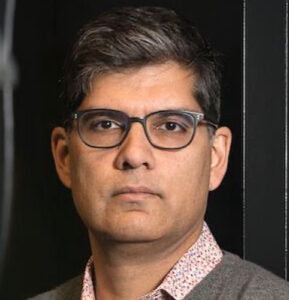
 Sandeep Robe
rt Datta\, MD\, PhD
Sandeep Robe
rt Datta\, MD\, PhDAssociate Professor
Department of Neurobi ology
Harvard Medical School
Sandeep Robe
rt Datta\, MD\, PhD
Associate Professor
Department of Neurobi
ology
Harvard Medical School
Hosted by: Ahmad J ezzini\, PhD
This talk will be presented in-person and via Zoom.
Webinar link: https://bit.ly/DoNSem
inarSeries
Spontaneous behavior exhibits structure. Ethologists d escribing animals in the wild have long appreciated that naturalistic\, sel f-motivated behavior is built from modules that are linked together over ti me into predictable sequences. And yet\, it remains unclear how the brain r egulates the selection of individual behavioral modules for expression at a ny given moment\, or how it dynamically composes these modules into the flu id behaviors observed when animals act of their own volition\, and in the a bsence of experimental restraint\, task structure or explicit reward. Here we use novel methods for characterizing and manipulating behavior in freely -moving mice in real time to reveal that learning and variability interact to create the architecture of self-guided behavior. Our findings suggest a broad model in which the composition of spontaneous behavior from elemental components is supported by the same circuits and mechanisms that enable ac tion selection in structured tasks.
CATEGORIES:Seminar Series LOCATION:Moore Auditorium\, North Building GEO:38.634886;-90.261692 ORGANIZER;CN="Brian":MAILTO:bmarston@wustl.edu URL;VALUE=URI:https://neuroscience.wustl.edu/events/event/sandeep-robert-da tta/ END:VEVENT BEGIN:VTIMEZONE TZID:America/Chicago BEGIN:DAYLIGHT TZOFFSETFROM:-0600 TZOFFSETTO:-0500 DTSTART:20220313T080000 TZNAME:CDT END:DAYLIGHT END:VTIMEZONE END:VCALENDAR