Burkhalter honored for studies on cerebral cortex and vision (Links to an external site)

Andreas Burkhalter, PhD, a professor in the Department of Neuroscience at WashU Medicine, has received the 2026 Krieg Cortical Kudos Discoverer Award from the Cajal Club, a scientific research society. The award recognizes scientists whose research has advanced understanding of the cerebral cortex and its connections within the brain.

Remembering Dr. Gerry Fischbach, former department chair 

Dr. Fischbach was a leader in synapse neurobiology and an advocate for collaborative and open science Gerald “Gerry” Fischbach, M.D., a renowned neuroscientist and former chair of the WashU Medicine Department of Neuroscience, passed away at age 87 on Sunday, October 25th at his home in Westchester, New York. Dr. Fischbach was recognized as a […]

Disrupt Neuroscience: Inaugural live podcast recording event hosted by the Department of Neuroscience

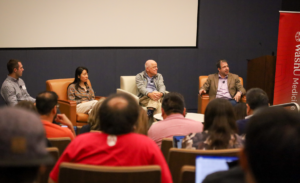
Inaugural live podcast recording of Disrupt Neuroscience brings together great minds from across St. Louis in science, innovation, and entrepreneurship  The air bristled with anticipation. Colleagues whispered in corners over their lunch. Introductions echoed across the rows of seats. Old friends waved across the room. New and familiar faces filled the auditorium at Fort Labs […]

Yi Lab publishes study in Nature revealing molecular players in Angelman Syndrome

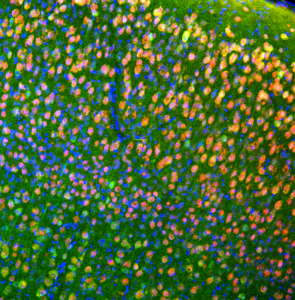
Researchers have shown in mice that slowed brain growth in Angelman’s syndrome is caused by elevated levels of a molecule called asparagine synthetase (green). NeuN (red), a marker for mature neurons, is stained here as well as a DAPI counterstain to show DNA (blue). Image courtesy Jason Yi.

Angelman Syndrome impacts roughly 1 in 20,000 births. It is a neuro-genetic disorder that impacts patients’ movement, sleep, and cognitive function. There is no cure for Angelman Syndrome, and often patients live as long as anyone else, but with far more difficulty due to the seizures, intellectual disability, and speech impairment (among other symptoms) caused […]

Post-doctoral fellowship applications are open now with the Center for Theoretical and Computational Neuroscience

A cityscape sits under a pink and purple sky as the sun sets.

The Center for Theoretical and Computational Neuroscience (CTCN) at Washington University in St Louis invites applications from outstanding postdoctoral fellows to work at the interface between theoretical and experimental neuroscience labs at WashU. The deadline for applications is Dec 1st 2026. The CTCN is a joint initiative between the Schools of Medicine, Engineering, and Arts […]

Han Lab publishes study revealing neuronal circuit for remembering rewarding places

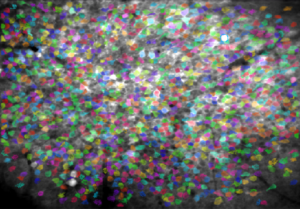
Neuron cells imaged under a microscope in a wide array of colors against a black and white background.

Cognitive maps help us understand where we are, and remember how to navigate the world. For example, your brain (specifically, your hippocampus) has a map of your home – where tofind the kitchen, the bathroom, the bedroom, and so on. But it’s also important for your mental map to include the locations of things you […]

Rosa-Molinar receives dual honors from scientific societies (Links to an external site)

Eduardo Rosa-Molinar, PhD, a professor of cell biology and physiology, and of neuroscience at WashU Medicine, has received prestigious honors from two scientific societies: the American Society for Cell Biology, which named him a 2026 fellow, and the Histochemical Society, which named him the 2026 recipient of the Anna-Mary Carpenter and Ellen M. Rasch Award. These honors recognize Rosa-Molinar’s scientific excellence, mentorship and research in cellular imaging.

Build-up of common enzyme stunts brain growth (Links to an external site)

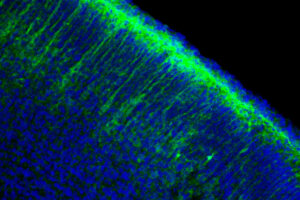
Image shows neurons expressing the molecule that is the central focus of this paper, called ASNS.

New research from Jason Yi, PhD, assistant professor of neuroscience at Washington University School of Medicine in St. Louis, has found in mice that the missing UBE3A gene is the first domino in a biological sequence that leads to a normally harmless enzyme accumulating in the brain. The buildup is not harmful on its own but appears to have indirect effects that ultimately impair brain growth.