Li’s research will investigate the link between maternal immune activation during fetal development and the development of neurological disorders.
Tristan Qingyun Li receives Brain & Behavior Research Foundation grant

Li’s research will investigate the link between maternal immune activation during fetal development and the development of neurological disorders.

The project aims to answer a fundamental question in neuroscience: how do olfactory cues direct behavior?

The Zhao Lab is grateful for ICTS, GTAC@MGI, Knight ADRC, and the Movement Disorders Center for their generous support.
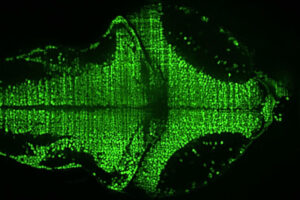
In collaboration with labs from Caltech and the University of Southern California, his team will track each cell in the zebrafish brain to document the biological basis of sleep.
Zhao, an assistant professor in the Department of Neuroscience, will apply imaging mass cytometry technology to analyze tissue samples from Alzheimer’s patients.

The $500,000 award will go toward studying cellular influences on neuromodulator function.
The $7 million grant awarded to a team of collaborators is part of the NIH’s new Impact of Genomic Variation on Function Consortium.

The project aims to refine recombination-mediated cassette exchange (RMCE), an approach to inserting large DNA sequences into the genome, for use in the model organism C. elegans.

Richards, the head of the Department of Neuroscience, will apply the high-risk, high-reward grant to developing a new animal model for studying brain development.

Along with co-PI Hong Chen, associate professor of biomedical engineering, and collaborators including neuroscience professor Larry Snyder, Monosov will adapt an approach to controlling brain activity, called optogenetics, with the ultimate goal of repairing neural dysfunction.