“Uncovering Neural Circuit Dynamics Across Regions and Contexts”
Ram Dyuthi Sristi 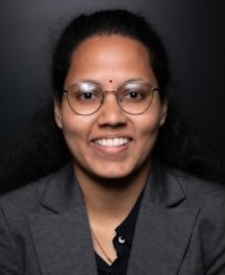
PhD Student
University of California, San Diego
Understanding how neural circuits interact across brain regions to encode behavior and adapt under changing conditions is a central challenge in neuroscience. Large-scale recordings capture activity across multiple areas, but extracting interpretable signals from such data requires new computational tools. I will first present Coupled Transformer Autoencoder (CTAE), a sequence model that disentangles shared versus region-specific dynamics while modeling long-range temporal dependencies. By partitioning latent space into orthogonal shared and private subspaces, CTAE uncovers inter-regional communication signals and local computations. Applied to motor cortical recordings during a reach task and multisensory recordings during decision-making, CTAE improves behavioral decoding over existing methods for multi-region analysis. Next, I will introduce Conditional Stochastic Gates (c-STG), a contextual feature selection method that identifies neuronal subpopulations encoding behavior across contexts such as task epochs or stimulus conditions. Using a hypernetwork to map context variables to probabilistic feature-selection gates, c-STG improves both accuracy and interpretability. Applied to motor cortical recordings, a single c-STG model revealed compact subpopulations that predicted trial outcomes from trial timing or reward type. Together, these approaches parse shared and context-dependent neural structure, enabling testable hypotheses on circuit reorganization and inter-areal communication.
View all events from the Center for Theoretical & Computational Neuroscience at WashU »