Anthony Pappas brings his neuroscientist researcher background to medical education.
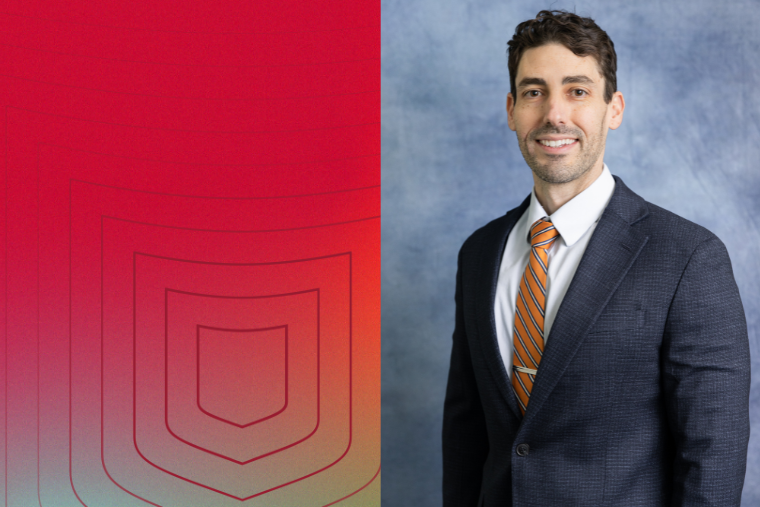
As a medical educator, Anthony Pappas, PhD, is thrilled to be in an evolving field constantly seeking to teach students better and adapting what and how it teaches.
“Medical education is becoming more learner-centered, integrated and adaptive,” said Pappas, who joined the Department of Neuroscience in June as an assistant professor of anatomy in neuroscience on the clinician track-educator pathway. “There’s a greater emphasis now on active learning and helping students apply foundational science knowledge in clinical contexts earlier. There’s also a push towards developing internal quality improvement measures.”
Pappas comes to WashU Medicine after serving as an assistant professor of anatomical sciences and vice chair of the Department of Anatomical Sciences at the Rocky Vista University College of Osteopathic Medicine. He has been a medical educator for over seven years, teaching cadaveric anatomy to medical, physician assistant and master’s level graduate students, while also serving in various ancillary roles, including research advisor, course director and gross anatomy lab manager.
At WashU Medicine, he is active in the first phase of the school’s Gateway Curriculum, focusing on modules that include an anatomy component. Outside of the medical school, he is teaching a neuroanatomy course to students enrolled in a graduate-level nurse anesthesia program.
During his teaching career, he has established a teaching philosophy consisting of two main pillars: understanding the needs of his audience and cultivating a welcoming learning environment.
“What are the students preparing for?” Pappas asked. “A career in health care, research or are they simply trying to advance their understanding of a topic without a definite application? For the second pillar, I am not the type of faculty who wants my students to feel intimidated or uncomfortable about any topic, or to feel judged by me or their peers. These things hinder learning and need to be eliminated as best as possible.”
His talent as a dedicated anatomical scientist and educator has been acknowledged by students and peers, including earning the 2020-21 Faculty Rookie of the Year and the 2024-25 Best Teaching Faculty awards at Rocky Vista.
He has also been inducted into the Academy of Educators at WashU Medicine, which is an institutional collaboration of educators focused on fostering a culture of educational excellence and a community of health science education leaders. Members are recognized for their substantial contributions to education and their integral role within the WashU Medicine education mission.
A move from a research-intensive career to education
Pappas earned his PhD in neuroscience at the University of Vermont and worked as a postdoctoral researcher in ophthalmology at Harvard Medical School before pivoting from a research-intensive trajectory to one more aligned with his passion for education and mentorship. It was a gradual but natural shift, Pappas said. As much as he found research rewarding, his teaching in graduate school reawakened his curiosity and reminded him why he pursued neuroscience in the first place.
“Teaching allowed me to revisit the full landscape of the field — not just the narrow slice I was investigating in the lab,” he said. “Teaching brought a more immediate sense of purpose and fulfillment. I also genuinely enjoy working with people and seeing that moment of realization when a complex concept clicks. Watching students connect with the material — and find it as fascinating as I do — has been incredibly meaningful.”
While he concentrates on education, his research efforts still inform his work, either through research presentations at conferences or publications. His current research interests are exploring ways to apply concepts in neuroscience to education.
“I recently collaborated with a radiologist to study the development of visual expertise in medical students trained in ultrasound,” he said. “We were shocked at how quickly this skill developed and how long it persisted for some students even after formal training had ended.”
As he transitions from basic science research to education research, he said, his research also makes him a better educator by serving as an evidence-based guide for the development of new teaching and assessment methods.
Now, Pappas has brought all his experience and assets to WashU Medicine.
“WashU has an incredible track record for producing top-notch medical professionals, including many outstanding physician-scientists,” he said. “I’m honored to be part of the WashU team so I can contribute to this mission and leave my thumbprint on some of these scholars’ training experiences.
“Moreover, the WashU faculty have proven to be very collaborative and focused on achieving educational excellence. This is great for me. I know there is a lot I can learn from my colleagues here, and I’m very excited to work closely with them.”