The project aims to refine recombination-mediated cassette exchange (RMCE), an approach to inserting large DNA sequences into the genome, for use in the model organism C. elegans.
Michael Nonet receives R01 grant to improve transgenesis method
The project aims to refine recombination-mediated cassette exchange (RMCE), an approach to inserting large DNA sequences into the genome, for use in the model organism C. elegans.

Richards, the head of the Department of Neuroscience, will apply the high-risk, high-reward grant to developing a new animal model for studying brain development.

Along with co-PI Hong Chen, associate professor of biomedical engineering, and collaborators including neuroscience professor Larry Snyder, Monosov will adapt an approach to controlling brain activity, called optogenetics, with the ultimate goal of repairing neural dysfunction.

Richards and other representatives from the International Brain Initiative will discuss methods of advancing international neuroscience collaborations at this event from the Panel for the Future of Science and Technology (STOA).

The BRAIN Initiative funding will improve the ability of light field microscopy to record the activity of all neurons across the entire larval zebrafish brain as the animal swims freely.
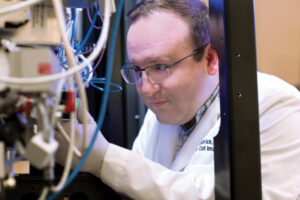
The Washington University Center for Cellular Imaging will add a Zeiss LSM 980 Airyscan 2 microscope platform to its world-class collection of instruments.

Bauernfeind has made substantial contributions to the development of a new medical school curriculum and has been honored with multiple teaching awards.

The funding will support research on the function of a subset of microglia, immune cells that reside in the brain.

Yi studies UBE3A, the protein that is lacking in individuals with Angelman syndrome.

This year’s keynote speakers are Tallie Baram, PhD, from the University of California, Irvine and Viviana Gradinaru, PhD, from the California Institute of Technology.