Items
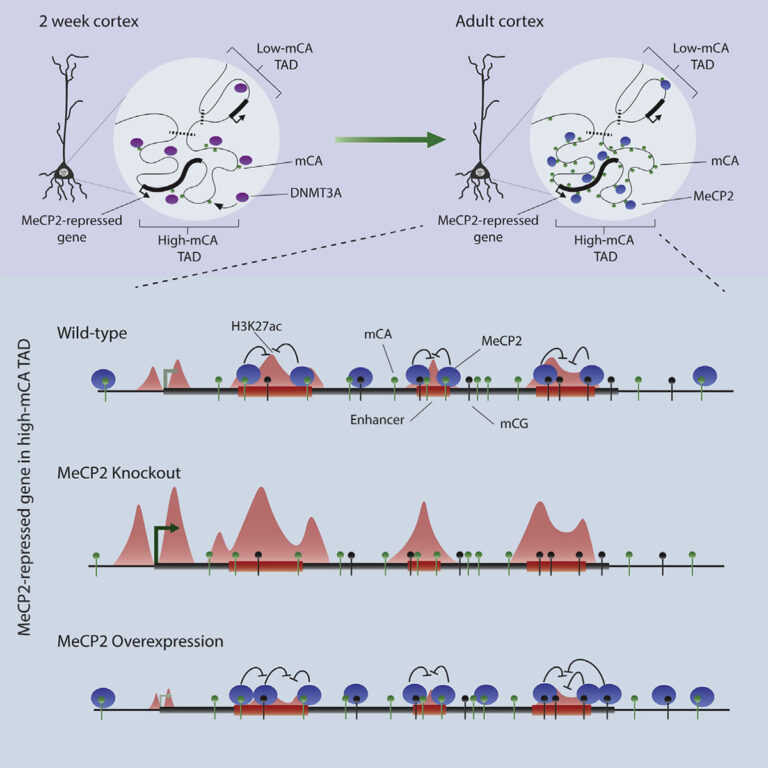
MeCP2 represses enhancers through chromosome topology-associated DNA methylation
Clemens*, A. W., Wu*, D. Y., Moore, J. R., Christian, D. L., Zhao, G. & Gabel, H. W., Jan 16 2020, In: Molecular Cell. 77, 2, p. 279-293.e8


Mildred Trotter Lecture
The Mildred Trotter Lecture invites accomplished women scientists to share their work. The distinguished event honors Mildred Trotter, PhD, who was a member of WashU Medicine for more than 55 years.

Monosov Lab
Neuronal basis of voluntary behavior
The Monosov Lab is interested in the neuronal basis of voluntary behavior. What are the neuronal mechanisms that control exploration and learning? How do different attributes of behavioral-options impact our decision-making?
Morhardt Lab
Imaging & paleoneurology of dinosaurs
IoDino (i·o·dy·no) Lab is a multidisciplinary space that uses classic and cutting-edge techniques to study the form, function, and evolution of modern and extinct animals. The lab strives for excellence in scholarship, teaching, and outreach. The IoDino Lab focuses on inferring and digitally reconstructing soft tissues in extinct vertebrates, specifically dinosaurs. We are particularly interested in the paleoneurology (evolved form and inferred function) of dinosaur brains.
Nonet Lab
Neuronal cell biology
Research in the Nonet Lab focuses on understanding the cellular and molecular mechanisms mediating neuronal synapse development. The lab addresses this complex problem using a combination of genetic, molecular and image techniques using both the nematode C. elegans and the teleost Danio rerio.
Optical Engineer/Imaging Scientist (Postdoctoral Research Associate/Staff Scientist/Senior Scientist)
Neuroscience
The successful applicant will design, build, and characterize innovative optical instruments for fluorescence microscopy applications in Dr. Yao Chen's laboratory.
O’Malley Lab
Intracellular GPCR signaling
The O'Malley Lab is interested in the molecular and cellular bases of neurological and neuropsychiatric disorders. In particular, the lab is interested in signal transduction pathways mediated by metabotropic glutamate receptors such as mGluR5. These receptors are widely expressed throughout the CNS and play important roles modulating neuronal excitability during brain and synapse development and in learning and memory.
Padoa-Schioppa Lab
Neuronal mechanisms of economic choices
PI: Camillo Padoa-Schioppa, PhD
Research in the Padoa-Schioppa Lab focuses on the neurobiological mechanisms of economic choice (a.k.a. neuroeconomics). The lab combines behavioral, neurophysiological and computational techniques to understand how the brain makes decisions.
Papouin Lab
Astrocytes in brain circuits & cognition
Since its inception, neuroscience has focused on neurons as the single most relevant cellular component of the nervous system for understanding its inner workings. Yet, parts of the mammalian brain are only comprised of 10-20% of neurons. The Papouin lab explores the role played by the remaining 80-90% of “non-neuronal” cells, called glial cells, in brain function. The lab is interested in understanding the role of a glial subtype, astrocytes, in brain function from the perspective of brain states.