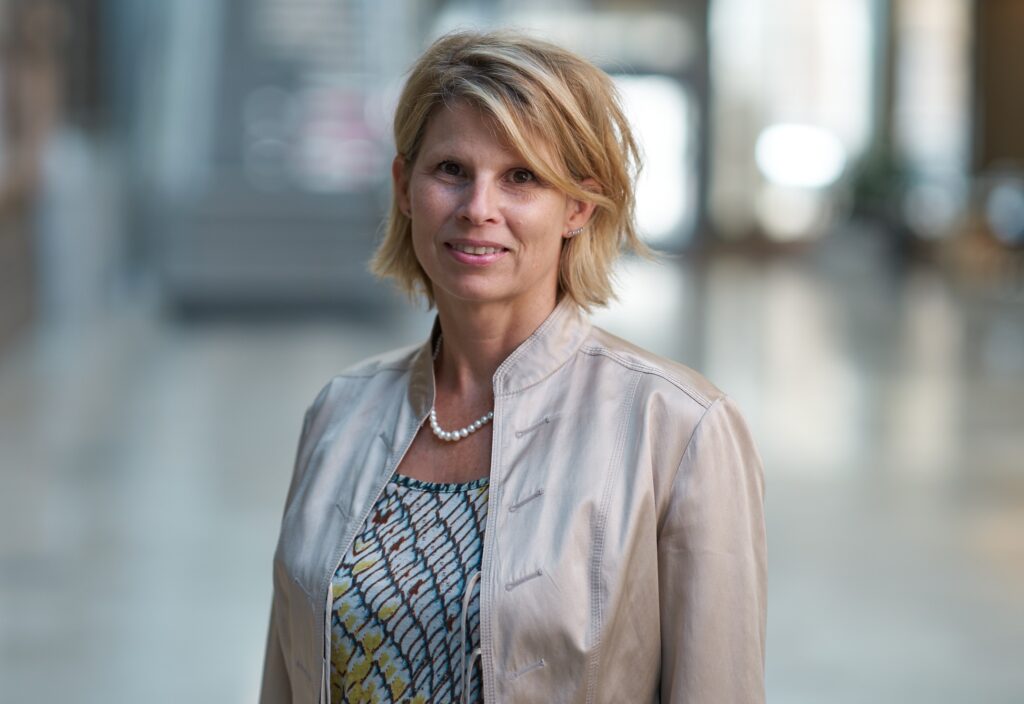
Valeria Cavalli, PhD, was honored at the Geneva Chemistry & Biochemistry Days in January 2026, where she received the Jaubert Award for her contributions to understanding the molecular basis for neuronal regeneration.
The Jaubert award is given every two years and recognizes the work of alumni of the University of Geneva, where Cavalli graduated from three times, earning her bachelor’s degree in 1991, master’s degree in 1992, and her doctoral degree in 2000, making her the ideal (and well-deserving) candidate for this recognition.
“If you can think about your science anytime — at the grocery store, while you’re cleaning your house, that’s what happens with me. I think that’s what it takes to be a scientist, to be really driven to answer all the questions that we ask,” she said.
Cavalli is the Robert E. and Louise F. Dunn Professor of Biomedical Research and Professor of Neuroscience, and has been with WashU for nearly two decades. Her work focuses on the molecular basis of neuron regeneration — specifically, how the peripheral nervous system undergoes regeneration at the cellular level, something that the central nervous system is not capable of. This regenerative ability is what differentiates a smaller injury from something that could result in paralysis.
Her research interests have always been guided by data, Cavalli said — from her work in graduate school, to her postdoctoral work, to her lab’s current focus, every question has been connected by what was happening in neurons at the molecular and cellular level.
“I didn’t start my postdoctoral research project knowing that I wanted to repair nerves or work on paralysis — after doing an experiment to look at proteins moving through axons, it was really looking at my data that led me to the hypothesis of injury signalling,” she said. This initial hypothesis was what funded her fellowship from the Christopher Reeve Foundation, and helped govern the direction of her research lab at WashU.
Cavalli is excited to follow her data to her next line of questions, which focus on satellite glial cells, which envelope part of sensory neurons and could play important roles in sensory dysfunction and aging.
“These cells surrounding the sensory neurons — the glial cells — are really understudied, and I was fascinated by their morphology. I want to know more about them because they regulate pain and sensory function, and are altered in disease and aging,” she said.
Cavalli was nominated for the Jaubert Award by the current director of the Department of Biochemistry at the University of Geneva, Professor Aurelien Roux, who was inspired by the talk she gave the last time Cavalli visited her alma mater in 2014.
The Jaubert Award recognizes University of Geneva alumni who have made significant contributions to science and humanity, and Cavalli’s work on the molecular mechanisms at play in nerve cells has certainly shifted the way scientists think about neurodevelopmental disorders, especially sensory disorders, and aging.
Author: Serina DeSalvio, freelance writer supporting the Department of Neuroscience.