Read Dr. Ashley Morhardt’s take on the paper in an article in Science.
Some dinos may have been as brainy as modern primates, controversial study argues (Links to an external site)

Read Dr. Ashley Morhardt’s take on the paper in an article in Science.
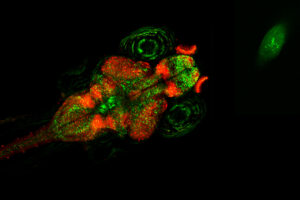
A new study from the Goodhill Lab finds the genetic variant underlying an autism disorder causes changes in fish’s social behavior, preference in visual environment, and neural activity.
Read graduate student Katie Lefton’s article in Science Today about astrocytes, microglia, and satellite glial cells.
Matthew Glasser, a former graduate student of Van Essen and currently an Instructor in Radiology, also made the 2022 list.
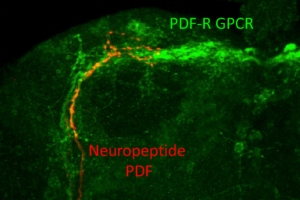
Phosphorylation of a receptor controls how messages from the neuropeptide PDF—which influence dawn and dusk activities in Drosophila—are curtailed on a daily basis to adapt the circadian clock to changing daylight.
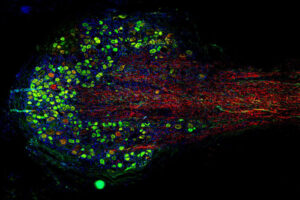
Valeria Cavalli, PhD, and Guoyan Zhao, PhD, are among the collaborators at WashU participating in the Integrated Research Center for Human Pain Tissues (INTERCEPT) Pain Center at the School of Medicine.
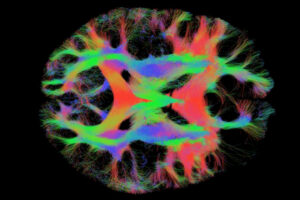
A study of individuals with congenital corpus callosum dysgenesis suggests they face social difficulties due to being more easily influenced and less aware of being tricked.

The McDonnell Center for Systems Neuroscience Small Grants Program will provide $100,000 over two years.

A new study on fruit flies from Dr. Paul Shaw’s lab finds clues to a good night’s sleep, insomnia.

The $2-million grant will go to identifying the circuits and computations responsible for integrating novelty- and reward-seeking in behaviors.