Items

Ritzman Lab
Comparative anatomy of primate skulls
The Ritzman Lab is interested in the comparative anatomy of the skull in primates as it relates to human evolution. The lab employs the comparative method and direct studies of fossil hominins to make inferences regarding the evolutionary processes that operated during the course of human evolution, as well as the patterns, documented by the fossil record, that were produced by these processes.
Salkoff Lab
Ion channel biology
The Salkoff Lab studies potassium channels which are key elements which control and shape electrical activity in the brain, heart, and other excitable tissues. These channels are major determinants of behavior and higher brain function.

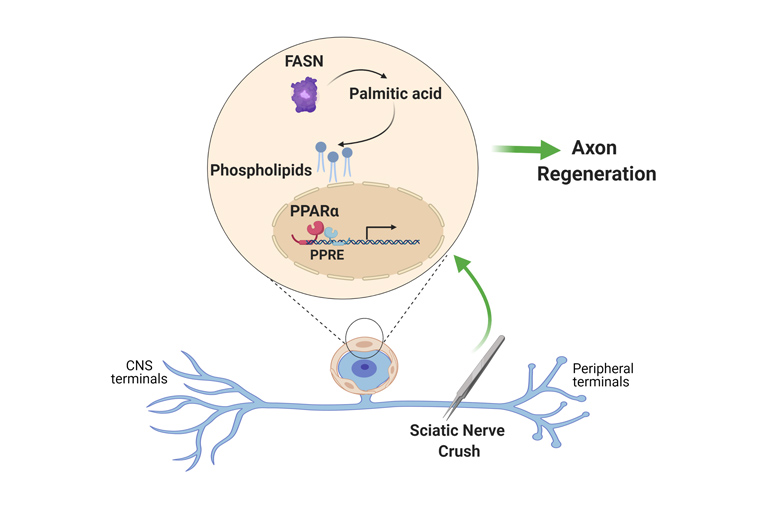
Satellite glial cells promote regenerative growth in sensory neurons
Avraham, O., Deng, P. Y., Jones, S., Kuruvilla, R., Semenkovich, C. F., Klyachko, V. A. & Cavalli, V., Dec 1 2020, In: Nature communications. 11, 1, 4891.
Shaw Lab
Sleep & plasticity
PI: Paul Shaw, PhD
The Shaw Lab uses the genetic model organism Drosophila melanogaster to elucidate the molecular mechanisms linking sleep to neuronal plasticity. The lab has demonstrated that we can fully restore cognitive functioning to a diverse set of classic memory mutants simply by enhancing their sleep. In these experiments, sleep was able to reverse cognitive deficits without restoring the causal molecular lesion or structural defect. In addition sleep reversed cognitive deficits in two separate models of Alzheimer’s disease.
Snyder Lab
Small circuits underlying behavior
The Snyder Lab studies small circuits underlying cognition in the non-human primate model. Currently, the lab has projects involving spatial representation, memory and movement; eye-hand and bimanual coordination; and correlation-based functional connectivity.
Staff Scientist (Oviedo Lab)
Neuroscience
The Oviedo lab is conducting groundbreaking research on the development of the brain's communication centers and how they are impacted by neuropsychiatric disorders.
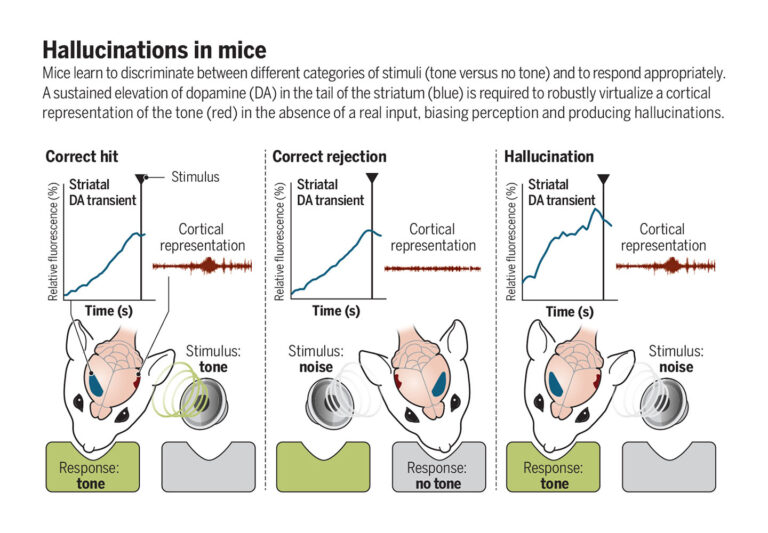
Striatal dopamine mediates hallucination-like perception in mice
Schmack, K., Bosc ,M., Ott, T., Sturgill J.F., Kepecs, A., Apr 2 2021; In: Science. 372(6537).
Taghert Lab
Circadian neural circuits
The Taghert Lab seeks to understand the organization, regulation and outputs of circadian neural circuits in the Drosophila brain. The lab takes advantage of the remarkable molecular genetic methods that are available with this model system.
Tavoni Lab
Theoretical and computational neuroscience
PI: Gaia Tavoni, PhD
The Tavoni laboratory develops theories and models to understand how information is represented and processed in neuronal networks, and how brain computations adapt to changing environments and conditions. Areas of focus in the lab include coarse-grained and biophysical models of perceptual learning, statistical physics approaches to memory consolidation and retrieval, Bayesian and complexity theories of high-level cognition, and data-driven models of decision circuits.