Camillo Padoa-Schioppa, PhD, has developed a manual of tools for analysis of economic choices.
New primer on logistic models for research in decision neuroscience

Camillo Padoa-Schioppa, PhD, has developed a manual of tools for analysis of economic choices.
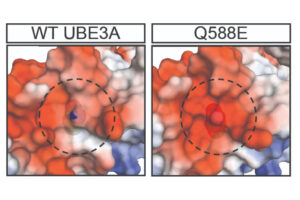
Assistant Professor Jason Yi’s group applied the technique to variants of unknown significance in UBE3A, the gene that underlies Angelman syndrome.

The $500,000 award will go toward studying cellular influences on neuromodulator function.
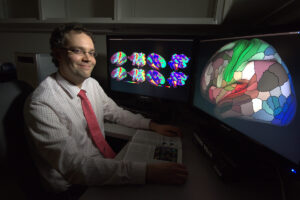
As a graduate student in the Department of Neuroscience, Glasser came to be a leader in the Human Connectome Project.
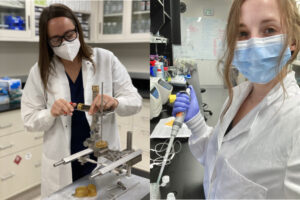
Our laboratory animal technicians are the backbone of basic research that relies on animal models.

Sengupta, a postdoc in Martha Bagnall’s lab, earned third place for illuminating the connectivity of spinal interneurons in zebrafish.
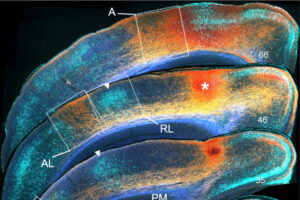
The Burkhalter lab finds that areas are embedded within a hierarchical network in which image fragments from the retina are sent through bottom-up pathways to extract percepts, and top-down pathways from higher to lower areas provide prior knowledge for interpreting the visual scene.

Bauernfeind, an associate professor in the Department of Neuroscience, is the first to hold the position for the department.

Monosov lab demonstrates that neurons in the zona incerta are responsible for the motivation to seek novelty.

The cognitive neuroscientist at Macquarie University got his first wet lab experience as a postdoc at WashU, and now addresses those same questions about hand-eye coordination and sensory-motor integration in his research on surgeons’ skills.