Skip to content Skip to search Skip to footer
WashU Medicine

Department of Neuroscience

Menu
  • About
    • Vision and Mission
    • Department History
    • St. Louis
    • Contact Us
  • People
    • Faculty
    • Emeritus Faculty
    • Affiliate Faculty
    • Administrative Staff
    • Research Staff
    • Trainees
    • Alumni
  • Research
    • Publications
    • Neuroscience Building
    • Facilities
    • Resources
    • Department and WashU Contacts
  • Education
    • Postdoctoral Research
    • Faculty Awards
    • Graduate Rotations
    • Outreach
    • Body Donor Program
  • Opportunities
    • Positions
    • INSPIRE
  • News & Events
    • Department Events
    • Department News
    • Calendar of Events
  • Giving

News

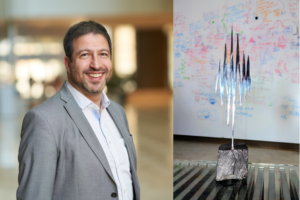
Adam Kepecs selected for Buzsáki Lecture Award by Hungarian Neuroscience Society
By Kerry Grens and Brian • February 6, 2023October 15, 2025
Adam Kepecs and the Buzsaki Lecture Award stature--a metal sculpture of a sharp wave ripple

Professor Kepecs presented at the Joint Meeting of the Austrian Neuroscience Association and the Hungarian Neuroscience Society on his approaches to developing methods to accurately model human psychiatric disorders.
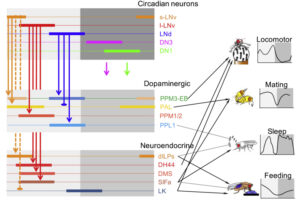
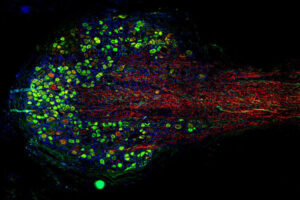
Daily activity schedules mapped in the Drosophila brain

By Kerry Grens and Brian • January 17, 2023March 6, 2023
Diagram illustrating the functional connections between circadian pacemaker neurons, downstream dopaminergic and neurosecretory centers, and daily behaviors

Cellular circuits downstream from circadian pacemaker neurons direct normal daily rhythms of feeding, mating and sleep.

Some dinos may have been as brainy as modern primates, controversial study argues (Links to an external site)

Science • January 12, 2023March 6, 2023
Ashley Morhardt

Read Dr. Ashley Morhardt’s take on the paper in an article in Science.

Sustainability key focus in Neuroscience Research Building construction (Links to an external site)

School of Medicine news release • January 11, 2023March 6, 2023
This rendering shows a large rooftop terrace on the third floor of the Neuroscience Research Building that can be used as a gathering place for employees and as an event space.

Facility on track to achieve LEED Gold certification

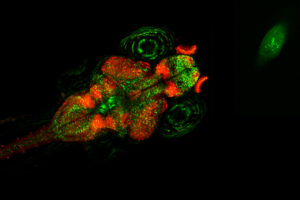
Zebrafish advance as a model organism for Fragile X Syndrome

By Kerry Grens and Brian • January 9, 2023March 6, 2023
A zebrafish with its nervous system fluorescently labeled in green and red hunts a paramecium, fluorescently labeled in green

A new study from the Goodhill Lab finds the genetic variant underlying an autism disorder causes changes in fish’s social behavior, preference in visual environment, and neural activity.

Glia: Unsung heroes of the nervous system (Links to an external site)

Science Today • January 3, 2023March 6, 2023
Katie Lefton and gray Washington University shield logo

Read graduate student Katie Lefton’s article in Science Today about astrocytes, microglia, and satellite glial cells.

David Van Essen listed as Highly Cited Researcher for eighth consecutive year

By Kerry Grens and Brian • December 9, 2022March 6, 2023
David Van Essen

Matthew Glasser, a former graduate student of Van Essen and currently an Instructor in Radiology, also made the 2022 list.

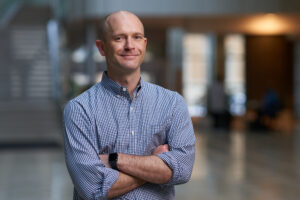
Harrison Gabel promoted to Associate Professor

By Kerry Grens and Brian • November 30, 2022January 9, 2023
harrison gabel

Dr. Gabel receives tenure for his pathbreaking research on epigenomic regulation of brain development and neurodevelopmental disorders, along with his devotion to mentoring and teaching.

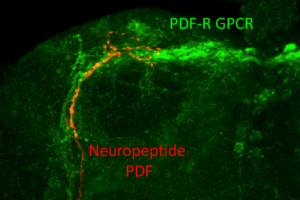
Taghert Lab identifies off switch for a set of circadian clock–controlled behaviors in flies

By Kellan Weston and Brian • November 30, 2022February 22, 2023
microscope image of the Drosophila brain, fixed and double-stained for PDF (red fluorescence) and PDF-R (green fluorescense)

Phosphorylation of a receptor controls how messages from the neuropeptide PDF—which influence dawn and dusk activities in Drosophila—are curtailed on a daily basis to adapt the circadian clock to changing daylight.

Understanding, treating pain, reducing opioid use, aim of $11.7 million grant (Links to an external site)

School of Medicine • November 4, 2022January 9, 2023
Pictured is a microscopic view of a human dorsal root ganglion. The nerve tissue is stained to reveal the cell bodies (in green) and axons (in red) of neurons that sense and transmit pain sensations.

Valeria Cavalli, PhD, and Guoyan Zhao, PhD, are among the collaborators at WashU participating in the Integrated Research Center for Human Pain Tissues (INTERCEPT) Pain Center at the School of Medicine.

Posts navigation

Previous Page
11 of 21
Next Page

Department of Neuroscience

WashU Medicine

CB 8108

660 S. Euclid Ave.

St. Louis, MO 63110

314-362-3033

Contact Us

  • LinkedIn
  • Twitter

Learn more

Opportunities

Giving

Department Resources

Resources

Directory


©2026 Washington University in St. Louis